Most survey apps pay about $0.30 to $2.50 per hour over time for the average user.
You may occasionally earn more during short periods, but those moments come from temporary matches, not consistent availability.
The reward shown on a survey card only applies if you qualify and complete it, and most attempts never reach that point.
After several days of normal use, earnings settle into a low and uneven pattern because the majority of time is spent opening surveys, answering screening questions, or waiting for new ones to appear.
A good way to think about it: survey apps reward matching a study, not effort spent inside the app.
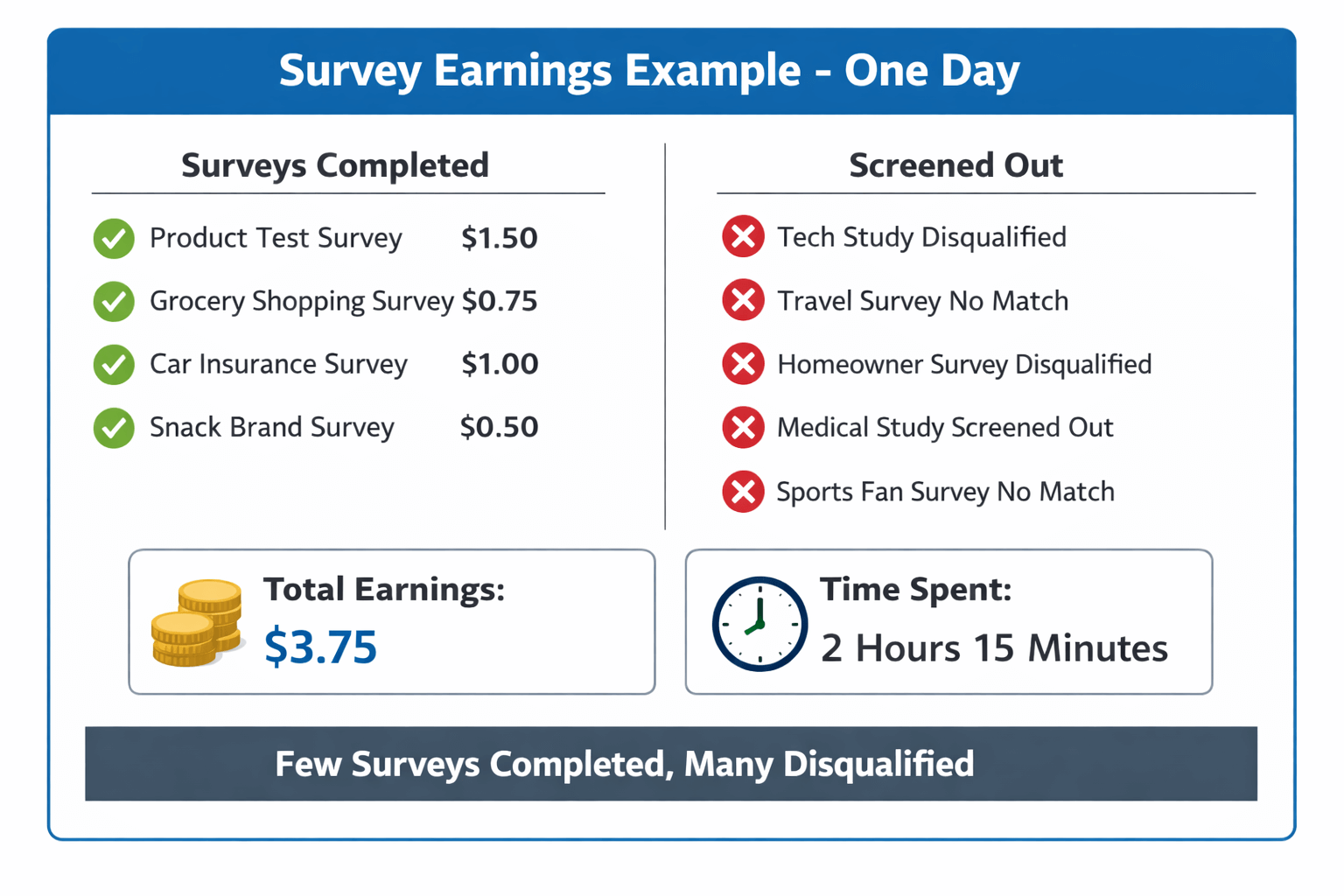
Two people using the same platform for the same amount of time can earn very different amounts because opportunities depend on research demand, not activity level.
This pattern is easy to notice on platforms like Freecash, Pawns App, and Poll Pay, where payouts look high at first but average earnings stabilize after a few days of normal use.
Typical Daily Earnings
Across most survey platforms, results settle into the same predictable pattern after a few days of use.
Low activity days
You open the app multiple times and either don’t qualify or complete one short survey.
Total earned: roughly $0–$1
Average days
You match a few studies spread across the day. Total earned: around $2–$5
Good days
Several surveys happen to fit your profile. Total earned: about $5–$12
Rare spikes
A higher paying study appears Not repeatable and usually followed by slower days
What matters is not the best day but the weekly average. When tracked across several days, earnings flatten because surveys appear in clusters and then disappear for long periods.
This behavior is common across platforms like HeyCash, Branded Surveys, and Opinionest, where a single good session can give the impression of strong income even though the following days return to typical levels.
The Real Hourly Pay (Time Math)
Most people calculate earnings by adding up completed surveys. That number is misleading because it ignores the time spent trying to reach those completions.
Real usage includes:
-
opening surveys that end early
-
answering screening questions
-
checking the app repeatedly
-
waiting for new studies
-
loading and routing between providers
Example scenario:
You complete 4 surveys worth $1.50 each → $6 earned
But your actual interaction looks like this:
-
Morning check: 10 minutes
-
Afternoon checks: 25 minutes
-
Evening session: 40 minutes
-
Background checking across the day: ~45 minutes
Total time involved: about 2 hours
Real hourly pay ≈ $3/hour
After longer use, successful matches become less frequent, so the hourly average usually drops closer to $1/hour.
The earnings don’t fall because you’re slower — they fall because qualifying opportunities become less common once the system understands your profile.
Why Earnings Drop After the First Week
Many users notice the same pattern: the first few days feel productive, then results slow down.
This happens because survey platforms are learning where you fit.
At the beginning, the system sends your profile to many studies to test compatibility.
You temporarily see more opportunities because the platform is still classifying your demographics and behavior.
After enough attempts, the system narrows your matches. You begin receiving only studies that closely target your profile.
That leads to:
-
fewer available surveys
-
more screening failures
-
lower daily totals
The app didn’t change — the filtering became more precise.
You can see this behavior on platforms like Mistplay, Gamehag, and Idle Empire, where early activity feels busy before settling into a smaller, more consistent number of available matches once the system understands your demographic profile.
Why Disqualifications Happen
Surveys are not general questionnaires.
They are targeted research samples.
Each study is looking for a very specific group of people. The questions at the beginning are not part of the survey — they are filters used to find that group.
For example, a study might need:
-
people who bought a certain product recently
-
drivers of a specific vehicle type
-
parents of children within a certain age range
If your answers don’t match the required group, the survey ends immediately.
This means disqualification is not random and not caused by answering incorrectly.
The system is simply checking whether you belong to the dataset the researcher needs.
Because most studies target narrow demographics, failing more surveys than you complete is normal.
The majority of attempts will always end early, and the payout structure already assumes that will happen.
Understanding this removes the expectation of steady work — participation depends entirely on whether your profile matches current research demand, not on how much effort you put in.
How Often Does Work Appear?
Most often, survey availability does not refresh continuously. It arrives in waves based on when research companies release studies.
Most new surveys appear during weekday business hours in the regions funding the research.
Outside those hours, the number of available matches drops sharply.
This is why checking the app late at night often shows very little activity, while mornings and early afternoons feel busier.
Another pattern is clustering. Several surveys may appear close together, followed by long quiet periods.
Refreshing the app repeatedly during those quiet periods rarely changes the outcome because no new studies are being distributed at that moment.
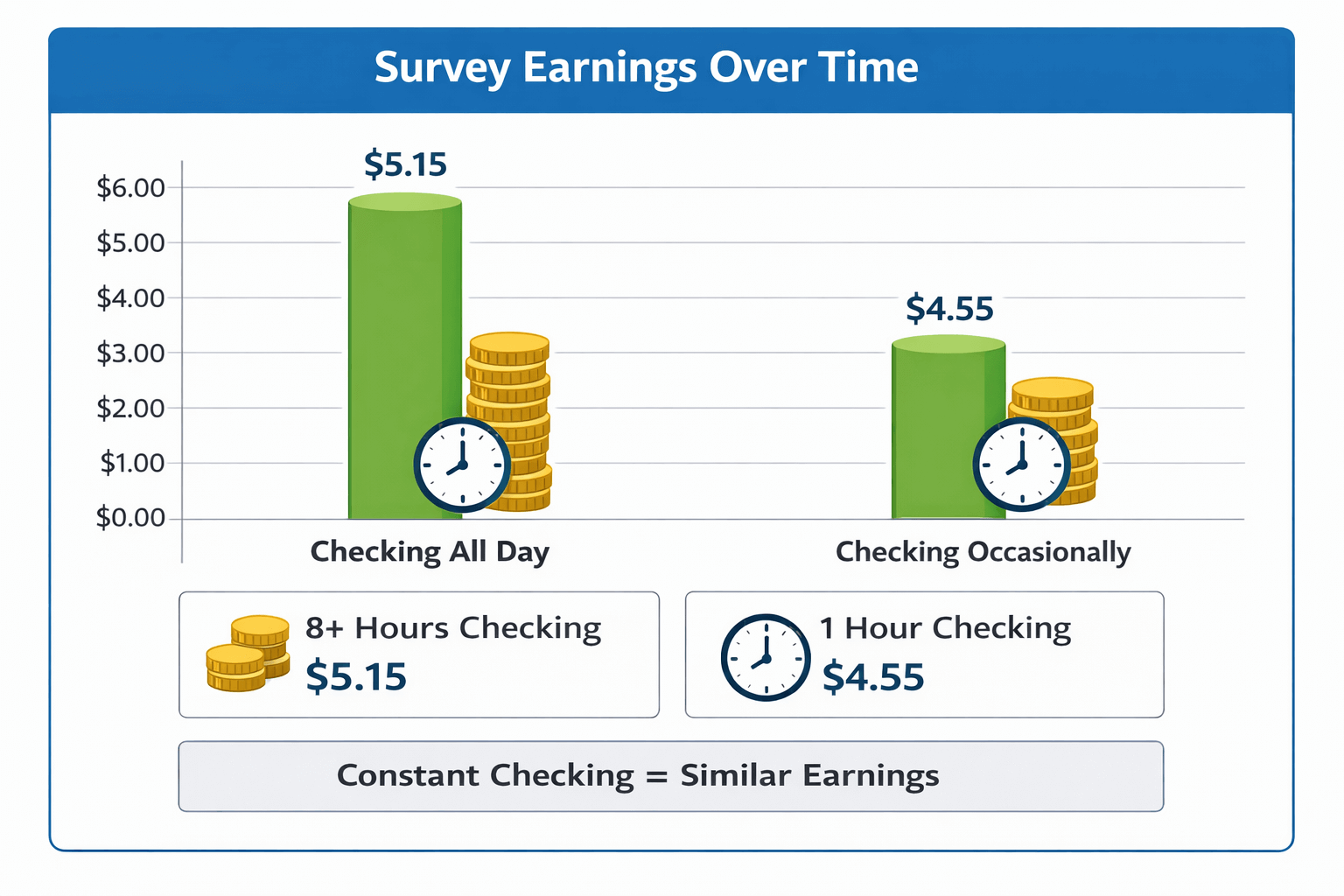
Because of this, checking the app five times per hour usually produces the same results as checking it a few times per day. The system is event-driven rather than continuous.
This is also why earnings feel inconsistent. Income depends on when research is released, not how frequently you open the app.
Example Platforms Behavior
Even though survey apps look different on the surface, their behavior follows the same pattern.
Higher advertised payouts usually come with lower qualification rates. Smaller surveys appear more often but produce very low hourly value. Occasionally, a high-reward study appears, but it does not repeat consistently.
Because of this, switching between apps rarely changes long-term earnings very much. The structure behind them is similar — they all connect to market research providers distributing studies to large pools of users. What changes is presentation, not economics.
So choosing the “best paying” platform usually affects short-term results, not weekly averages.
Who Survey Apps Work For
They suit people who have small pockets of idle time during the day.
For example, short waiting periods, commuting, or background phone use. In those situations, the time would otherwise remain unused, so even small payouts accumulate without replacing productive activity.
They also fit users who do not expect predictable income and are comfortable with irregular rewards. The apps function more like occasional bonuses than steady work.
Used casually, they feel reasonable. Used intentionally as a scheduled activity, they quickly feel inefficient.
Who They Do Not Work For
They work poorly for anyone trying to treat them like a job.
Setting aside a full hour to complete surveys usually leads to long stretches without matches. The system does not provide continuous tasks, so focused effort increases waiting time rather than earnings.
People looking for daily targets or consistent hourly returns usually become frustrated because availability depends on research demand rather than participation level.
The structure rewards occasional checking, not sustained sessions.
The Biggest Misunderstanding
Most users mentally track only successful surveys.
They remember finishing a higher paying study but not the attempts that led nowhere. Over time this creates the impression of better earnings than actually occurred.
When time spent checking, loading, and screening is included, the hourly rate becomes much lower than expected. The gap between perceived income and real income is mainly caused by ignoring unsuccessful attempts.
Tracking total interaction time usually changes expectations immediately.
When They Are Worth Using
Survey apps make sense when they replace inactive time rather than productive time.
Opening them briefly during existing downtime allows small rewards to accumulate without noticeable effort. In that context, the low hourly value matters less because nothing else was being replaced.
They lose value when they replace focused activities. The payout does not increase with attention, so dedicating full sessions usually lowers effective return.
The usefulness depends entirely on how they are used, not on the platform itself.
Someone checking once per day may earn a few dollars weekly, while someone checking constantly may only increase earnings slightly because availability doesn’t scale with effort.
Final Reality
Survey apps do pay users, but the payment is tied to matching specific research needs rather than working continuously.
Income appears irregular because opportunities appear irregular. The systems reward availability and demographic fit, not persistence or speed.
The realistic expectation is small, uneven rewards gathered gradually over time instead of consistent hourly earnings.
Average long-term survey earnings stay very low because most time is spent qualifying, not completing surveys.
These apps work best as occasional idle-time activities rather than reliable income sources.