Welcome to this Microworkers review. This is a microtask platform where you complete small online jobs for small payments.
It’s easy to join and doesn’t require special skills, but the pay is very low and depends heavily on task availability and approval.
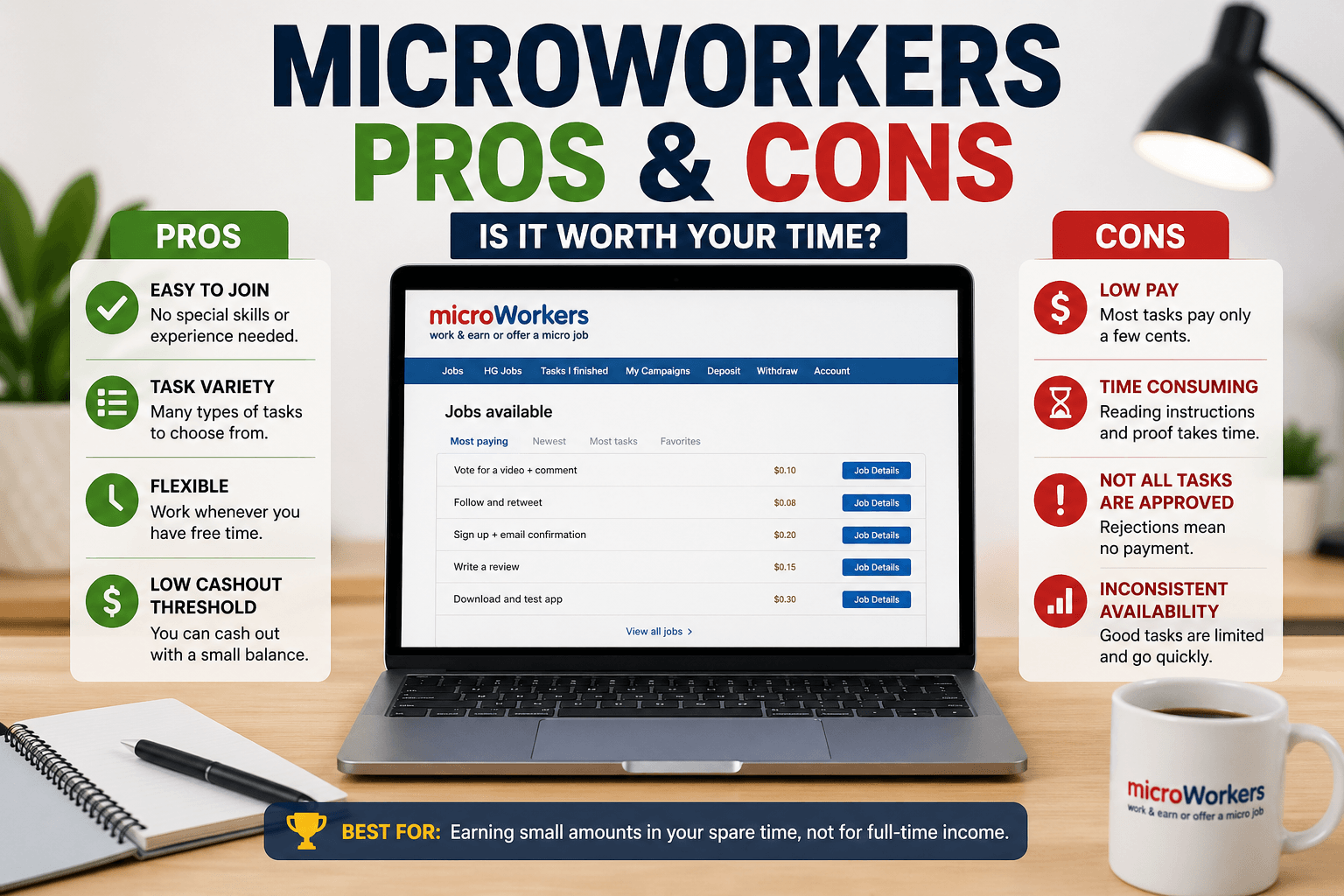
You can earn a few dollars here and there, but it’s not something you can rely on for consistent income.
Pros
-
Easy to get started
-
No special skills required
-
Wide variety of simple tasks
-
Available in many countries
Cons
-
Very low pay per task
-
Earnings depend on task approval
-
Inconsistent task availability
-
Not suitable for steady income
If you’re trying different platforms like this and not seeing much progress, it usually comes down to how these systems are designed. Most of them don’t reward time in a predictable way.
My Personal Experience With Microworkers
When I first signed up, it felt straightforward. I could browse tasks immediately and start working without going through any kind of testing process.
At the beginning, that made it seem more flexible compared to platforms that limit access early on.
The first few tasks were simple, but I noticed quickly that most of them required careful reading.
Missing a small detail could lead to rejection, so I had to slow down more than expected.
That alone reduced how many tasks I could realistically complete in a session.
After a bit of use, the main pattern became clear. Finding tasks wasn’t the problem — finding tasks worth doing was.
Many paid very little, and higher-paying ones disappeared quickly. I often spent more time checking listings and reading instructions than actually completing work.
Another thing I ran into was waiting for approval. Even after finishing tasks correctly, I had to wait to see if they would be accepted.
Some were approved without issues, while others were rejected with little explanation. That made earnings feel inconsistent.
Over time, it started to feel similar to other low-barrier platforms. It works, and you can earn small amounts, but the effort doesn’t scale in a predictable way.
The more time I spent on it, the clearer it became that it’s better suited for occasional use rather than something to rely on.
How Does Microworkers Work?
After creating an account, you get access to a dashboard where all available tasks are listed.
Each task includes instructions, a payout amount, and a time limit for completion.
The process is simple in theory:
You choose a task → complete it → submit proof → wait for approval → get paid if accepted
The important part is the proof step. Most tasks require you to submit something as verification, such as a screenshot, a link, or a short written response. If the proof doesn’t match the instructions exactly, the task can be rejected.
There is also a time limit for each task. Once you accept it, you need to complete it within that window. If you run out of time, the task expires and you don’t get paid.
Tasks are posted by different employers, so the quality and clarity of instructions can vary.
Some are straightforward, while others are more detailed and require extra steps.
This affects how long each task actually takes and how likely it is to be approved.
Payments are added to your balance only after approval. Until then, they remain pending.
This means your visible earnings are not always final, and part of your work may not turn into actual income depending on the outcome of the review.
If you’re testing platforms like this and noticing the same pattern—low payouts, inconsistent results—it’s not random. Most of these systems are built that way.
How Much Can You Earn With Microworkers?
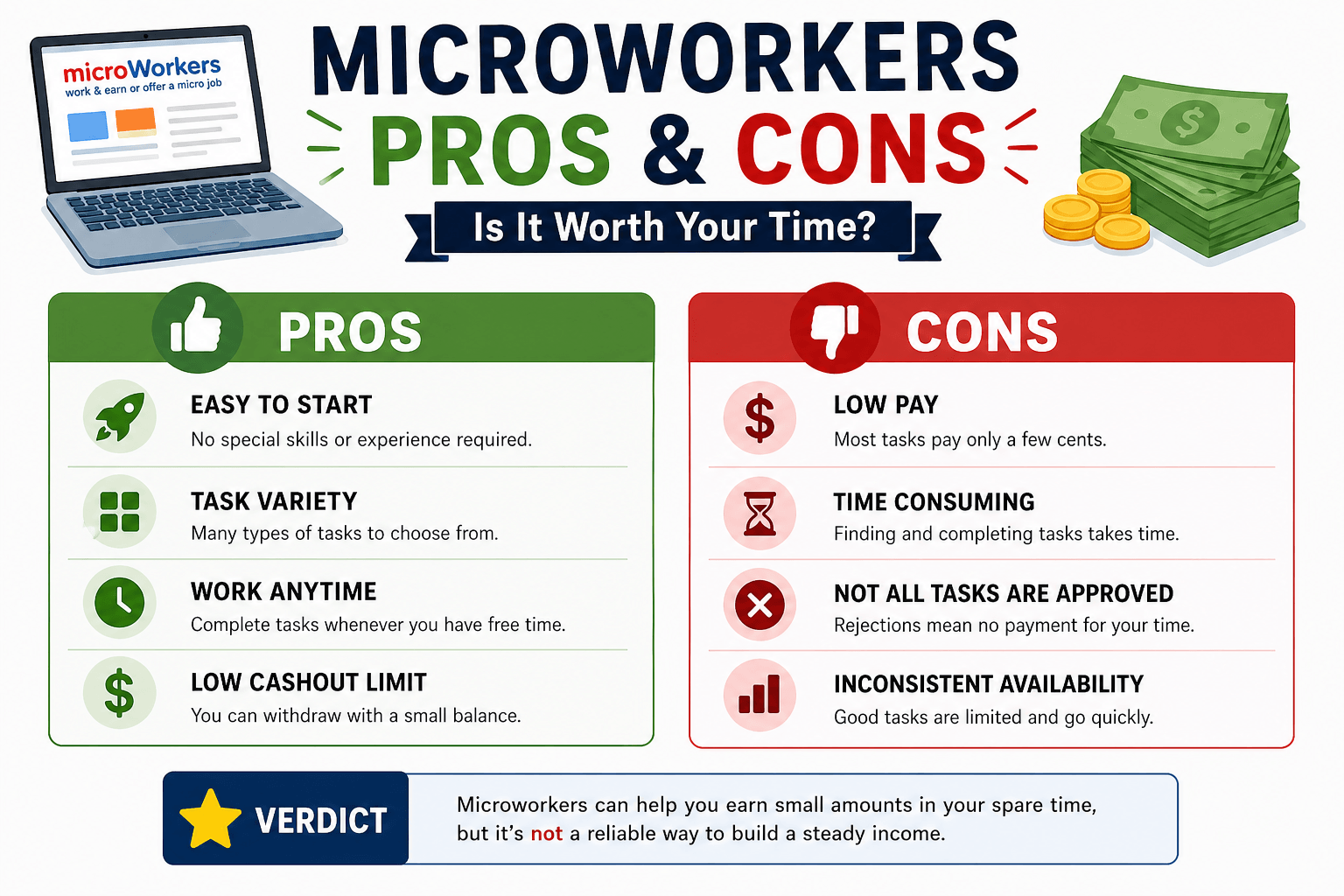
Earnings depend on how many tasks you can find and how many get approved.
Most tasks pay between a few cents and a few dollars, but the majority fall on the lower end.
In a typical session, you might complete several small tasks and earn a few dollars.
On some days, there are more opportunities, while on others, it can take a while to find anything worth doing. Because of this, income is not steady.
When you look at it over time, the hourly rate tends to stay low. Even if tasks are quick, the time spent searching, reading instructions, and submitting proof adds up.
Once you include that, the overall return is usually much lower than it first appears.
There is also the approval factor. Not every completed task turns into earnings.
Some may be rejected, which means time was spent without any payment.
The key pattern is that effort doesn’t scale in a predictable way. Spending more time on the platform doesn’t always lead to higher earnings.
Results depend more on task availability and approval outcomes than on how long you work.
Microworkers Pros and Cons
One clear advantage is how easy it is to start. There’s no complicated setup, no testing phase, and no waiting period before you can begin.
You can log in and start working right away, which makes it one of the more accessible options in this space.
Another benefit is task variety. You’re not limited to a single type of activity, and that flexibility makes it easier to avoid repetition.
If one type of task isn’t appealing, you can usually find something different, even if the pay doesn’t change much.
However, the low pay becomes more noticeable over time. Even when tasks are completed quickly, the total earned per session stays small.
Once you factor in the time spent reading instructions and submitting proof, the return often feels lower than expected.
The approval system is another major limitation. Since payment depends on the employer’s decision, there’s always some uncertainty.
Even when tasks are completed correctly, rejections can happen, and that time isn’t compensated.
Task availability also affects the experience. Some periods feel active, while others have very few worthwhile options.
Higher-paying tasks tend to be limited and get taken quickly, which makes it harder to maintain consistent progress.
Microworkers Final Verdict
Microworkers works, but the limitations are hard to ignore once you spend some time on it.
It’s easy to access, simple to use, and doesn’t require experience. You can log in and start completing tasks right away, which makes it appealing at first. But after a few sessions, the pattern becomes clear. Earnings stay low, tasks come and go, and approval adds uncertainty to the results.
The main issue is that effort doesn’t scale. Spending more time doesn’t reliably increase income because availability and approval matter more than how much work you put in. That makes it difficult to treat as anything beyond occasional use.
Compared to other platforms in this space, it follows the same overall structure. Small tasks, small payouts, and inconsistent availability. The difference is that you choose the tasks yourself, but that doesn’t change the long-term outcome.
In the end, it’s best seen as a way to earn small amounts during spare time rather than something you can rely on.